
All Wrapped Up: Braided Hair Lady
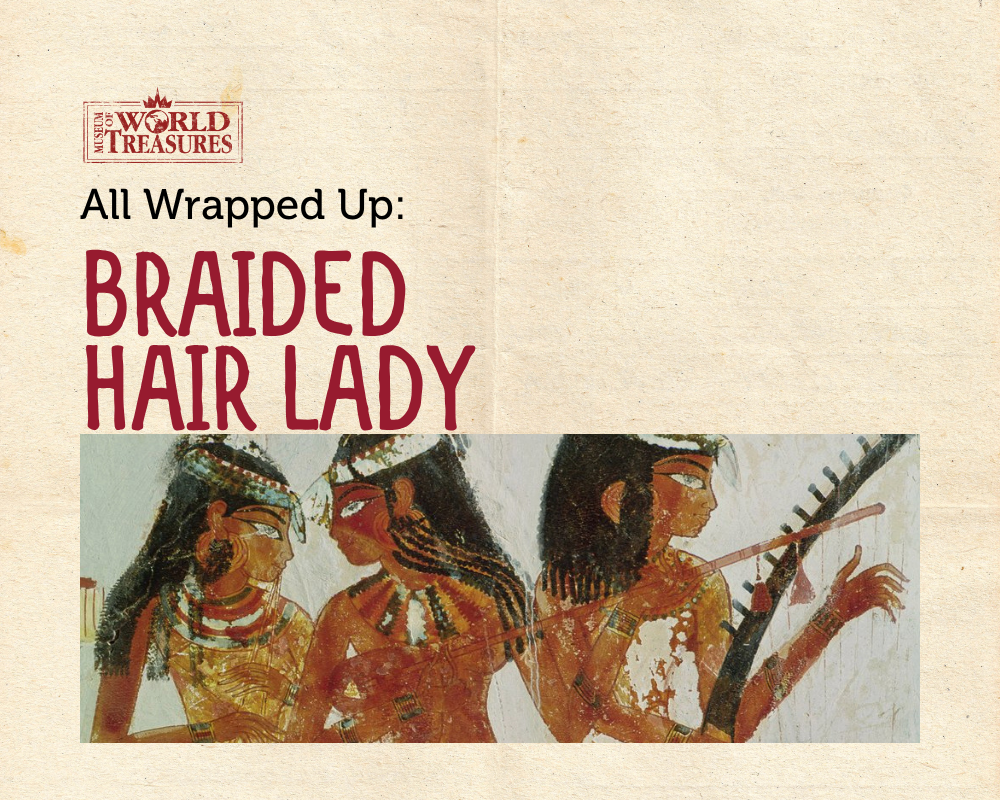
Museum artifact L2006.80.002, lovingly known as Braided Hair Lady, hereafter known as Lady, came to Wichita in 2004, joining Dr. Jon Kardatzke’s eclectic and ever-growing collection. Unlike her dear friend, Lady Baka, we know a great deal more about Lady. Why? Well, dear reader, let me tell you her story.
Before we discuss Lady more in depth, if you like what we are doing here you can support the Museum here. You can also follow us on Facebook and Instagram. Or you can join our mailing list below!
The Lady’s Tale
Lady was “found” in 1860 and brought from Egypt to Niagara Falls Museum in 1860 by Dr. James A. Douglas. She was part of their collection until 1999, when she was sold to the Carlos Museum alongside Baka. Sometime during her stay at the Niagara Museum, Lady was at least partially unwrapped from her linen bindings, leading to her present-day appearance.
There have been several studies and tests done to Lady. CT scans, X-Rays, and visual/physical examinations. Lady has had reports written by Dr. Redford, Dr. Harer, MD, and Dr. Brier, PhD. There are very few things these academics can agree on when it comes to Lady. These include: How old she was, was her body packed before wrapping, are her nails stained by henna, or what dynasty she came from, among other things. So here is the most comprehensive idea of what we know about Lady, based on my reading all of the current reports and paperwork in the museum files.
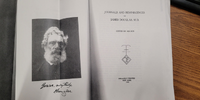
Dr. Douglas’s journal, edited by his son, recounts Dr. Douglas’s time in Egypt and his acquisition of Braided Hair Lady.
What We Know
The linen that she was wrapped in post mummification process was wrapped tightly around her, and the resin/bitumen was poured over it. This caused the linen to stick, making removal difficult, especially if done carelessly. Due to tight wrapping, it visually appears that Lady is missing both ears, but CT scans reveal that they are pressed flat to the skull and have residual linen and resin on them, making them hard to see. The CT also shows us that her lobes have large bore holes for earrings. Much of her current state can be attributed to the tight way she was wrapped and to the process and tools used in her mummification. The tight wrap has given her shoulders a hunched appearance, squashed the tip of her nose, and caused a slight deformation along the hairline. The tight wrapping may also be the reason why her hands are placed along the top of her pelvis instead of along her sides, which was the more common position. The hands laying on top of her body would have provided a tighter wrapping. Her fingers were also wrapped as one, instead of individually. Due to the partial unwrapping that was done, we can currently see three fingers on each hand. Visitors to the mummy room will note that the nails appear stained red. This is due either to staining from the bitumen used in the mummification ritual or could be left over from Lady’s nails being stained with henna during her life.
The quality of the mummification job is mixed. The linens used to wrap her body are of mixed quality, though it was very common for old bed sheets to be ripped up and used as bindings for all members of society. She may also have been wearing a linen dress before she was wrapped, but it is hard to tell, as the bitumen has caused all of the linen to fuse. There is evidence that not all of the natron, the substance used to dehydrate the body, was cleaned off the body before the wrapping ritual began. The fuller appearance of parts of Lady’s body can be attributed to the habit of packing materials under the skin to give a more life-like appearance. Given the robust nature of her bust, it is believed that her chest was packed, but there is no packing present in the abdominal cavity. Her eye sockets have also been packed with linen to prevent them from having a sunken look to them. Several of the doctors called in to look over Lady believed she may have been of a robust stature in life, which is why she has a fuller stature even after mummification.
The tests performed on Lady also show us that not all of her organs were removed, as was common. Her brain matter is present on the cranial CT scans, dried to the back of the cranium, and there is no evidence that her ethmoid bone has been pierced, as it would have been if removal had been attempted. There are also two organs left in her abdominal cavity. Neither organ is wrapped in linen, as was often the practice with organs that were removed and then replaced, so we can theorize that these organs, which are thought to be the spleen and liver, were left in place through the whole mummification ritual.
When measuring the long bones of Lady’s skeleton (generally the femur), there is a specific formula one can use to calculate the approximate height. This works for both ancient and modern humans, though there are different formulas for men and women and those of different ancestries. Using this formula, we can determine that she was around 4’10” during life. When measuring her from head to foot we get about the same measurement, so we can be certain that she was around that tall, which was below average for ancient Egyptian women. Bones do not shrink after death, though skin and ligaments will, so the height that mummies appear in death is very similar to their height in life. Her bones also help us to determine about how old she was when she died. X-Rays show that the ossification centers of the distal (lower) femur and the proximal (upper) tibia are nearly fused, but have not fused all the way. These growth centers generally finish fusing when you are in your early twenties. So, we can extrapolate that Lady was young when she died, likely early to mid-twenties. Her legs were wrapped separately to about mid-thigh and then were wrapped as one from there down, and unlike her hands, her feet are still fully wrapped, so we have no idea what condition her feet are in aside from what the x-rays have shown us.
Her teeth, though they look to be in bad shape now, were in good condition when she was alive. She has some traces of dental decay or cavities on her front teeth, but her back molars are in great shape. The damage done to her front teeth that is visible now was done post mortem (after death). The coloration or staining we see on the teeth is due to the bitumen that flowed into her mouth after the mummification process, and that bitumen can still be seen collected at the back of her throat. The X-rays that were done on her full body show that she also likely suffered from scoliosis in the thoracic (chest) region of her spine, but her bones were otherwise in good condition. She may have stood with uneven shoulders and it may have caused her some pain. Despite this, her bones and teeth show no other signs of disease or degenerative conditions.
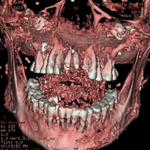
A scan of Braided Hair Lady’s skull and mouth. Significant medical testing and research was performed on our beloved lady here.
Her long braided hair, from which her name derives, is both her natural hair and extensions. It is tightly braided in sets of three and guests can see that the braids have held up well against the test of time. The reddish color of the hair is not the natural color she would have sported in life, but is a result of both the natron and the bitumen used in the mummification process staining the natural hair. Both substances have been shown to cause darkening of hair when tested in modern research. Close examination of her braids also revealed that Lady may have suffered from a modern beetle infestation, as the shell of a beetle larva was found in her hair during the physical examinations.
What Could Be
Based on the good health that Lady enjoyed, the good condition of her teeth, the elaborate hairstyle, pierced ears, and the possibility that she was “robust” in life with no signs of hard or repetitive labor shown on her bones, we can make the inference that Lady was well off in life. In Ancient Egypt this could be that she was minor nobility or even a priestess in one of the many temples. Both options would have offered her a better quality of life than many others would have enjoyed at that time. These “middle status” options could also explain why the mummification ritual was of middling quality.
According to the documents regarding her finding by Dr. Douglas, Lady was found in situ at Der al-Bahari, as part of one of the “royal caches”, a term used for the large groups of mummies found together in tombs that they did not belong in. We will discuss this more in a future blog. In the Niagara Museum she lay next to the mummy that was later identified as belonging to Pharaoh Ramses I (c. 1292-90 BCE), founder of Dynasty 19, otherwise known as the Ramessid Dynasty, leading to speculation that Braided Hair Lady could be someone of equal importance. And this is why the museum has so much more information on Lady than we do on Lady Baka. The theory was that Lady could be Queen Tiye, a secondary wife of Ramesses III (c. 1185-54 BCE), who orchestrated the Harem Conspiracy to place her son Pentawer on the throne instead of the chosen successor Ramesses IV. And so, a bevy of tests was done in an attempt to get more information to see if we could discover her identity. This theory has since been debunked due to information gathered by the series of tests that were done by various individuals.
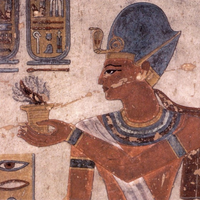
A tomb depiction of Ramses III in the Valley of the Kings. Ramses III was murdered in the Harem Conspiracy to put his son Pentawer on the throne.
We do not have a definitive dating range for when Lady lived though, as radiocarbon-14 dating is prohibitively expensive and requires the destruction of the, albeit small, sample, and we lack any burial items or coffin to use for contextual dating. The hair style that Lady sports was popular during the Third Intermediate Period (1070-664 BCE) and several of the experts thought that the earliest that Lady could be from would be sometime during the 18th Dynasty (1550-1292 BCE). There was a coffin set in the Niagara collection that was historically associated with Lady, Niagara items NFM C7 and C8 which belonged to a lady named Law-tays-heret, but as the collection was broken apart and sold separately, we have neither information about Law-tays-heret or where the coffin ended up. However, if that coffin set was Braided Hair Lady’s, it is one more point in her favor of being well off, as the documents we do have list it as being a well-made cedar coffin. Cedar is not native to Egypt and would have been imported from the Levant, or modern-day Syria, which would have been an extravagant expense.
Someday we may be able to run more tests on both of our beloved ladies and find out more about who they were and what their lives were like. Someday we find out what happened to their coffins and see the inscriptions for ourselves. For now, though, we honor, love and cherish them as they are, invaluable parts of our collection and of history.
